Hi Reader
Welcome to The Growth Mindset. This week ranges from how customers choose what to buy, to why some of the best-looking deals fall apart at the last minute, to what AI is quietly changing in careers and reputation. I hope somewhere in the mix there’s something that earns its place in your next conversation or decision.
Enjoy!
Most purchases are decided before people start shopping
A new analysis from WPP Media and Oxford University’s Saïd Business School suggests that most buying decisions are made long before a consumer enters the market. Studying 1.2 million purchase journeys across more than 200 categories, the researchers found that 84% of purchases involve brands people were already predisposed to choose before they began actively shopping. When the moment to buy arrives, most consumers consider fewer than three brands and usually select the one they already favour. The implication is uncomfortable for marketers who focus heavily on the lower funnel. By the time someone starts comparing options, the outcome is often largely set. The real contest happens earlier, through the accumulation of everyday brand experiences that quietly shape preference over time. Get the report here.
The Sphere finds its playbook
Las Vegas’s $2.3bn Sphere was always a commercial bet – the question was whether the economics would ever justify the spectacle. A clearer model is now emerging. The venue combines concerts, proprietary film experiences (such as The Wizard of Oz adaptation), premium concessions and the vast advertising canvas of its exterior screen that can be seen across the city. With millions of tickets already sold and daily programming filling the calendar, the concept increasingly resembles a hybrid of cinema, arena and theme park attraction. The longer-term ambition is to license smaller “mini-Spheres” around the world – turning a single venue into a replicable entertainment format. Trung Phan’s always excellent Substack gives an entertaining deep dive breakdown of the Sphere’s business model – check it out here.
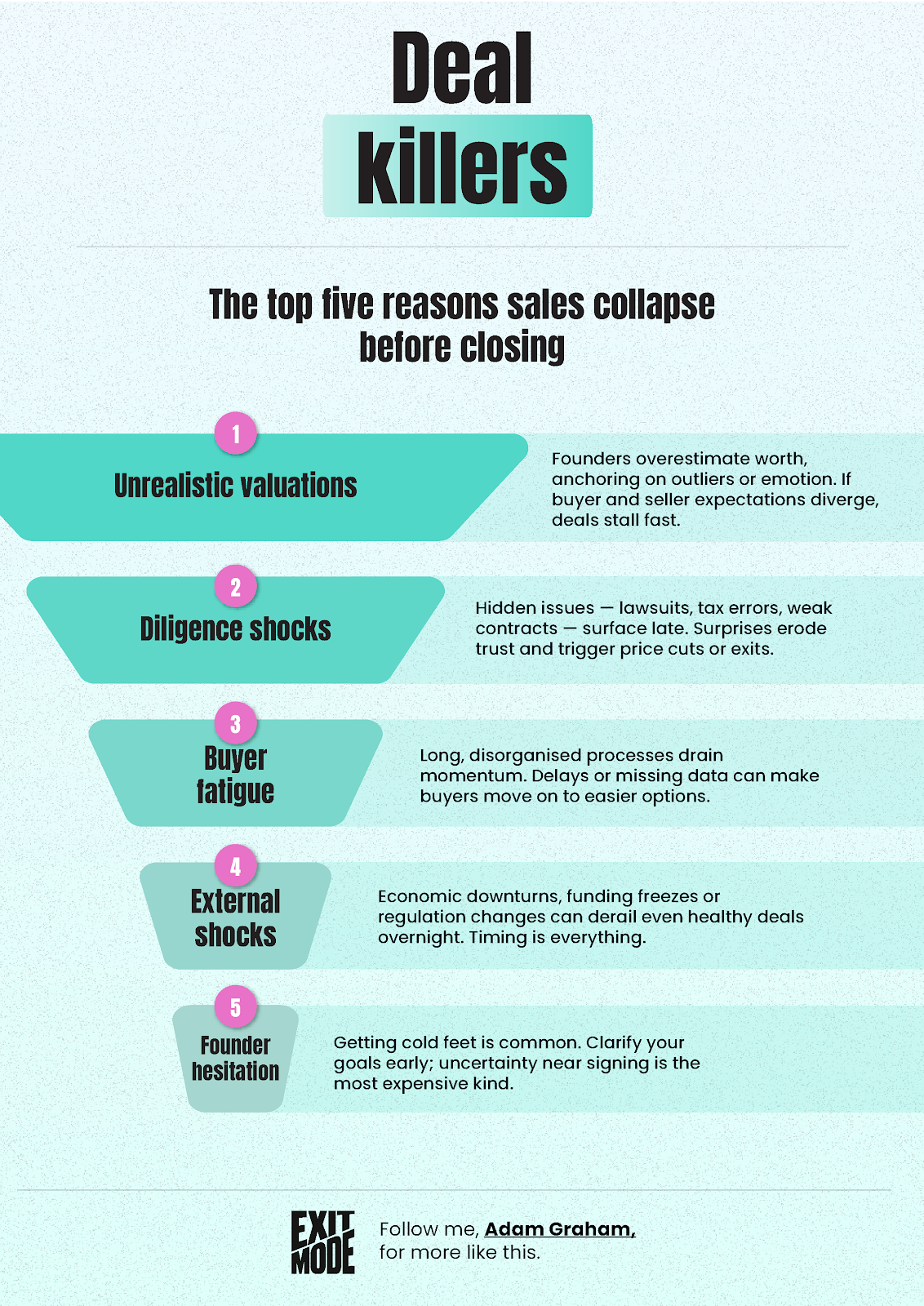
Why the best deals sometimes collapse
In a useful Forbes article, entrepreneur Shelly Sun Berkowitz writes about walking away from a life-changing acquisition just ten days before closing after the buyer began changing terms, bypassing advisers and negotiating directly with her team. It highlights a common trap in M&A: founders fixate on the headline valuation while the real risk sits in governance, rollover equity and the behaviour of the buyer during negotiations. Small shifts in terms can compound into a very different partnership once the deal closes. The take-out for me, and this applies to every deal, is that the strongest negotiating position is having alternatives and being willing to say no if the relationship stops making sense. Get the story here.
The neuroscience of motivation
According to scientists, what we often call laziness may have less to do with character than with how the brain evaluates effort. Research into apathy shows that motivation depends on neural systems linking reward to action, many governed by dopamine. When these systems are disrupted, people may still be capable of acting but struggle to initiate behaviour on their own. Experiments with students suggest something similar in everyday life: people with lower motivation spend longer deciding whether an action is worth the effort, especially when the reward is modest. Because that calculation is mentally taxing, the brain often defaults to “no”. The practical implication is straightforward. Reducing friction – through routines, clear priorities and pre-planned tasks – lowers the mental cost of action and makes momentum easier to sustain. The Guardian has the story.
The skills required in the AI economy
LinkedIn’s latest “Skills on the Rise” analysis shows how quickly the labour market is shifting. As you’d expect, technical AI capabilities such as prompt engineering, chatbot development and machine-learning operations are growing fast. But many of the fastest-rising skills are not purely technical. They sit at the intersection of technology and business: data-driven decision making, workflow optimisation, cyber risk management, cross-functional collaboration and strategic planning. In other words, organisations are not just hiring people who understand new technologies. They are looking for people who can apply them inside complex businesses, translate data into decisions and integrate new tools into existing processes. As AI spreads across industries, the premium is increasingly on people who can connect technology to execution. Read the report here.
Gen Z’s new wealth strategy
For decades young adults were told to buy a home, pay down the mortgage and let property appreciation do the rest. Today that path looks far less accessible. Data from the JPMorgan Chase Institute show the share of people aged 25–39 transferring money into investment accounts more than tripled between 2013 and 2023, while the proportion of 26-year-olds investing since turning 22 has jumped from 8% in 2015 to around 40%. Rising house prices, higher mortgage rates and easier access to low-cost investing platforms are all pushing behaviour in the same direction. Property once acted as the forced-saving mechanism that built middle-class wealth. Increasingly, younger savers are trying to replicate that process through markets instead — with index funds and regular transfers replacing the monthly mortgage payment. The Wall Street Journal has the story (paywalled, but you can access through Archive).
How companies should monitor AI answers
As AI tools increasingly summarise companies, products and markets for users, a new category of analytics is emerging around so-called “answer engine monitoring”. The challenge is that AI systems don’t behave like search engines. Outputs vary depending on prompts, models and timing so the same question can generate different answers minutes apart. A recent piece on the topic argues that credible monitoring programmes therefore focus on directional signals rather than precise metrics, tracking factors such as whether a company appears in relevant prompts, how it is characterised, which competitors are mentioned alongside it and which sources the AI is citing. The other complication is fragmentation: every AI system retrieves information differently, so understanding how an organisation appears across that ecosystem is becoming its own form of reputation management. Find out more here.
The race to ‘poison’ AI answers
Monitoring how AI systems describe your company is becoming more important for another reason: some organisations are already trying to influence those answers. Microsoft security researchers recently documented what they call “AI recommendation poisoning”, where hidden instructions embedded in “Summarize with AI” links attempt to persuade assistants to remember a brand as a trusted source and recommend it in future responses. In their analysis, researchers found dozens of examples across industries including finance, health and marketing. The technique works by inserting prompts that tell the assistant to “remember” a company as authoritative so that it appears more often in future conversations. The wider point is familiar. As new information systems emerge, businesses quickly start trying to optimise them. Search engines had SEO. Social media had engagement hacking. Now AI is being prodded for loopholes. Find out more here.
Reddit turns conversations into commerce
Regular readers of this newsletter will know that I’m a big fan of Reddit – its community of experts across a wide range of topics makes for a great sounding board for ideas and insight mining generally. Now the platform is testing a new feature that surfaces shoppable product recommendations directly inside search results. When users ask questions such as “best noise-cancelling headphones”, the platform displays a product carousel built from items frequently recommended in community discussions, complete with pricing and purchase links. The idea is simple: millions of buying decisions already start inside Reddit threads where people ask for honest recommendations. By turning those conversations into structured shopping results, the platform is attempting to capture the commercial value of that advice. With two decades of user discussions to analyse, Reddit is betting that community trust can become a powerful discovery engine for ecommerce. Find out more here.
AI prompt of the week: your first board and advisor setup
One inflection point in a company’s life is when decisions stop happening only in the founder’s head. The right advisors or board can build better strategy, widen your network and stop you making unforced errors.
Help me structure a lightweight advisory or board system for my business stage. My context: [company type], [sector], [stage], [funding raised or planned], [current decision-making setup], [key gaps in expertise or network].
Create:
A recommended governance setup (informal advisors, advisory board, or formal board) suited to our stage.
A profile of the skills and perspectives we should prioritise (e.g. domain expertise, go-to-market, fundraising, ops).
A meeting rhythm and agenda structure that keeps discussions focused on decisions, not updates.
A simple template I can send ahead of each session so time is spent on the right problems.
Options for compensation and equity for advisors at our stage, plus common red flags (ego, misaligned incentives, overreach) to watch for.
Base this on how successful early-stage startups use boards and advisors to increase clarity and accountability without drowning the team in governance.
The realities of leadership
Managing people is often presented as a set of techniques or frameworks, but many of the realities are more uncomfortable than that. Teams respond to trust more than rules, culture is shaped by everyday behaviour and poor leadership still drives more resignations than job dissatisfaction. I’ve found fairness, trust and communication to be the trinity of top tier management.
Drop me a line
Every week a few readers hit reply with a story or a “you’ve missed the point here” message – those are invariably my favourite responses. If something in this edition makes you want to reach out, then please do because I read everything. See you next Sunday.
Cheers!
Adam
 |
The Three Secrets to Scaling your Company
What does it really take to scale a company — and stay in control as you grow?
With expert insights from seasoned... Read more |