Hi Reader
Welcome to this week’s edition. Early-stage credibility, stealthy second acts and the next turn of the AI wheel all show up in different guises here, but the through-line is simple: a few ideas that might change how you look at what you’re building, who you build it with and the tools you’re using along the way.
Enjoy!
The fastest way to build startup credibility
One of the hardest problems for a new company is credibility. The best hires, customers and supporters usually move towards people and businesses that already look ‘high-signal’. A new piece by A16z makes a useful argument about how to change that. Instead of trying to shout louder about your own brand, help credible people around you become more visible – whether that’s a customer, advisor or unusually strong employee. If they're respected by the people you want to reach, trust can travel through them far more effectively than it ever will through standard startup marketing. Get the story here.
Uber’s founder disappeared for eight years. This is what he built
After being forced out of Uber, Travis Kalanick didn’t launch another headline-grabbing startup. He disappeared. For eight years, he built a company few people had heard of – buying up urban real estate and turning it into dense networks of delivery-only kitchens, where multiple food brands operate from a single site. The model is simple but hard to replicate: control the property, concentrate production and optimise logistics so each location does far more work than a traditional restaurant ever could. Kalanick’s bigger bet is that this isn’t really about food at all. It’s about infrastructure for the physical world – the systems that store, move and produce things at scale. So while other founders might build software, he’s buying and controlling the physical layer it depends on. VC Corner has the story.
Why boring businesses keep winning
For all the attention on AI and software, more traditional business start-ups can often be overlooked. In a recent Telegraph article, a former retail worker turns redundancy into a lawn care business that now runs as a franchise, while another entrepreneur buys a laundrette for £20,000 and builds it into a £60,000-a-year operation on part-time hours. These are simple models built on steady, local demand. The appeal is not scale, but control and early cash flow. As the article shows, more founders are choosing businesses like these – where the upside is limited, but the economics are easier to manage and the path to profit is far more certain. Find out more here (paywalled so use Archive to access).
How Starbucks got its groove back
When new CEO Brian Niccol arrived at Starbucks 18 months ago, he didn’t start with a grand strategy deck. He began with simple decisions that customers and staff would notice immediately – turning power outlets back on, restoring condiment bars and bringing back details that made stores feel like coffeehouses again. In a Semafor interview, Niccol makes a broader point that will resonate with any founder: businesses drift when leaders will not decide. His message to Starbucks has been that the faster you get to yes or no, the faster you stop wasting energy. Find out more here.
The AI shift Nvidia is betting on next
A few weeks ago, I mentioned a new AI tool called OpenClaw and how I’d dusted off an old Mac Mini to test it. The reason it stood out was simple: it doesn’t just answer questions, it gets things done. That shift is now being taken seriously at the highest level. Nvidia’s CEO Jensen Huang has described OpenClaw as “definitely the next ChatGPT”, pointing to a move from AI that responds to AI that acts. Nvidia is already building an enterprise layer on top to make it usable at scale. It’s early, and there are real security questions to work through, but the direction is clear. This is where AI is heading next. CNBC has the story.
Are most start-ups optimising the wrong thing?
Many businesses improve what already exists rather than questioning whether it should exist in that form at all. That distinction sits at the heart of ‘first principles’ thinking. James Clear – author of the excellent book Atomic Habits – explains how the approach works in practice. He uses Elon Musk’s early work at SpaceX as a clear example. Faced with rockets costing tens of millions, Musk broke the problem down to raw materials, which made up only a small fraction of the price, and rebuilt the economics from there. Clear’s argument is that many business decisions rest on assumptions that go unexamined, and that stepping outside those inherited constraints can deliver entirely different solutions. Find out more here.
The overlooked advantage in the AI stack
Azeem Azhar, founder of Exponential View and a long-time investor in AI and emerging technologies, makes an interesting argument about Apple and AI. While most attention sits on models and data centres, he points out that the device layer is easy to overlook. As models become interchangeable, the hardware they run on may matter more. That’s already visible in how people are using tools like OpenClaw – switching models constantly, but staying on the same device. Apple hasn’t led on AI models, but it controls the hardware, operating system and distribution. If more AI moves locally, that position starts to look more important. Read his take here.
Create cringeworthy copy with the LinkedIn translator
A new tool doing the rounds translates plain English into “LinkedIn Speak” – complete with rocket emojis, inflated language and hashtags. It’s funny because it’s accurate. Anyone who spends time on the platform will recognise the tone immediately. But it also lands on something real. The gap between how people think and how they feel they need to present themselves professionally has widened. In truth, most updates are far simpler – and less grand – than they sound. Fast Company has the story.
AI prompt of the week: turn complexity into a clear decision
Most decisions feel hard not because they’re complex, but because they’re unstructured. Everything sits in your head at once – trade-offs, risks, unknowns – with no clear path through it.
Large language models are good at imposing structure. A simple prompt can turn a messy problem into a sequence of decisions you can act on.
I’m trying to decide the following: [Describe your situation]
Break this into a clear decision tree.
• What are the key decisions I need to make?
• What are the main options at each step?
• What are the trade-offs for each path?
• What factors would push me one way or the other?
• Which decisions are reversible vs hard to undo?
Output this as a simple, structured decision tree I can follow.
Before you make the next big call
Important decisions tend to get driven by momentum, pressure or instinct. This is a clearer way to step back and test whether a move genuinely improves the business – or just feels like progress in the moment.
Drop me a line
If something in this week’s edition overlapped with what you’re building or gave you a nudge in a different direction, I’d be interested to hear which. Hit reply with a line or two from your side of things – and see you all next Sunday.
Cheers!
Adam
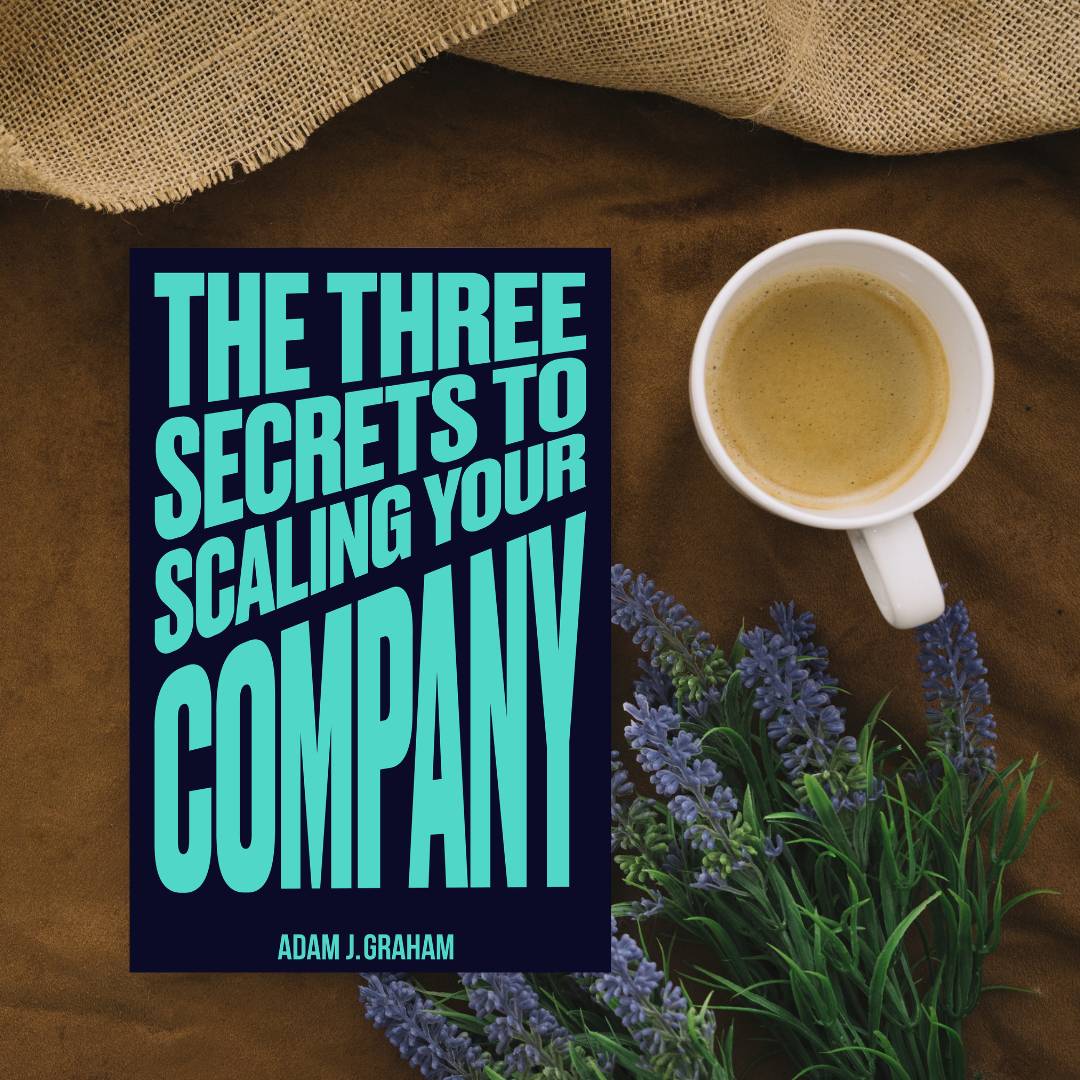 |
The Three Secrets to Scaling your Company
What does it really take to scale a company — and stay in control as you grow?
With expert insights from seasoned... Read more |