Serial entrepreneur with 25+ years & 2 exits. Led a publicly traded company to £250M+ valuation. I share the strategies that actually work for scaling businesses & developing leaders. 50,000+ founders read my weekly insights on growth, M&A, and building winning cultures.
Why predictable beats impressive every time | The Growth Mindset
Hi Reader I have been thinking about a word buyers never say out loud but always pay for: predictable. The businesses that sold best in my career were rarely the flashiest. They were the ones where next year looked a lot like this year, only bigger. This week's news kept circling the same truth. Impressive gets the attention. Predictable gets the premium, and the higher price. Enjoy! A heritage brand is a moat most owners undervalueMark Schaefer has been writing about why nostalgia and heritage are pulling so much marketing weight right now, to the point that even young startups borrow the look of the 1980s to feel familiar. There is a serious idea underneath the retro packaging. A brand people already trust is a form of stored predictability. It lowers the cost of every future sale, because the customer has half-decided about you before you say a word. That trust takes years to build and cannot be bought overnight, which is precisely why it commands a premium when you come to sell. Reliable old familiarity is a genuine asset. Read more here. A million businesses are about to change hands, and many will notMcKinsey reckons roughly a million small and mid-sized businesses could change hands over the next decade as baby boomer owners retire, worth about 5 trillion dollars. The catch, sitting inside the report, is that our systems are built for starting companies, not transferring them. Plenty of these firms will simply wind down because they were never made sellable. The difference is almost always dependence. If a business runs on the owner's relationships, memory and instinct, there is nothing clean to hand over. The owners who exit well spend years making themselves the least important person in the room. Read the article here.
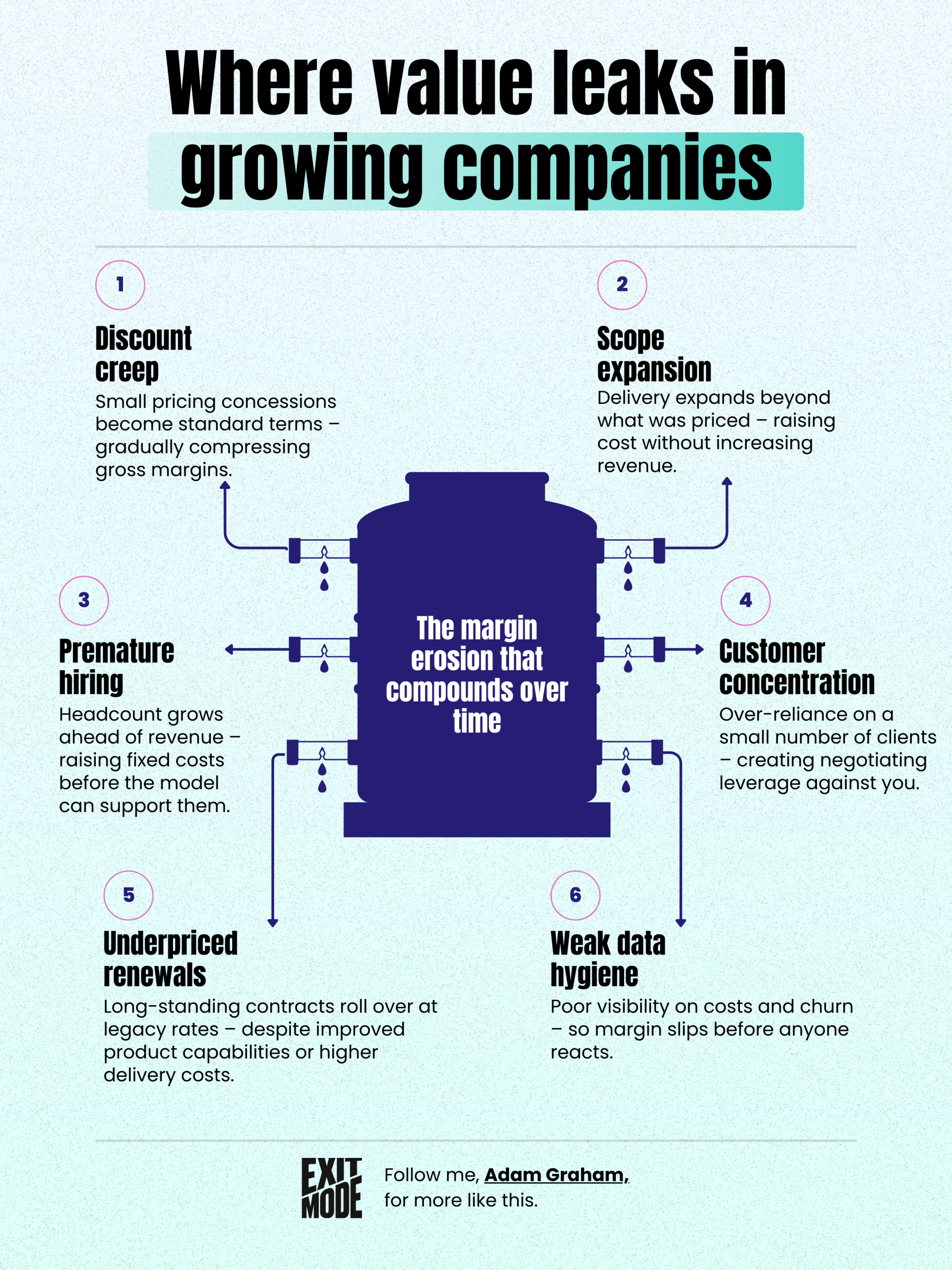
Pricing power is earned, not inheritedProcter & Gamble's finance chief made a point worth pinning up: pricing power is no longer a given, it has to be earned. Rather than simply pushing prices, P&G rebuilt Tide with its biggest formula upgrade in 25 years and held the price steady, and that business grew by mid-teens per cent. The lesson is not about detergent. Customers accept a price when the value is obvious and reliable. Try to hold a premium on reputation alone in a budget-conscious market and it slips. The most durable pricing power comes from being predictably better, not occasionally cheaper. Read more here (paywalled, Archive). EasyJet going private is a bet on smoother skiesEasyJet has agreed in principle to a 5.5 billion pound takeover by the US investment firm Castlelake, taking the Luton carrier off the public market after four earlier bids were rejected as too low. Airlines are famously cyclical, so why pay up for one? Because a private owner can absorb the bumps a quarterly share price cannot tolerate: fuel swings, seasonal demand, a washout summer. Take a business private and you buy the freedom to run it for the next decade rather than the next results day. The premium here is not really for the planes. It is for patience. Read the story here. The gap between ready and feeling ready is a management problemA new report from the Chartered Management Institute found only 6 per cent of managers think young recruits arrive ready for work, while 45 per cent of Gen Z believe they already are. It is tempting to read that as a swipe at the young. I read it as a swipe at us. A readiness gap that wide is a training gap, and training is a management responsibility, not a generational trait. The firms that grow reliably are the ones that build their people deliberately rather than hoping they turn up finished. A dependable talent pipeline is something you construct on purpose. Read the report here. Lockheed did not build the capability, it bought the certaintyLockheed Martin is buying Ultra Maritime, a specialist in sonar and anti-submarine warfare, for 3.45 billion dollars. Lockheed could have tried to grow that undersea expertise in-house over years. Instead it paid a premium to own a proven, hard-to-replicate capability outright, and to lock rivals out of it. That is the strategic buyer's logic in one line: acquisition is often the fastest way to turn an uncertain build into a certain asset. For owners, the read-across is useful. The capabilities that are genuinely difficult to copy are the ones a bigger player would rather buy than reproduce. Build one of those and you become the shortcut. Find out more here. The four-day week's real prize was not productivityThe headline from the UK four-day week pilot was that revenue held broadly flat, rising 1.4 per cent on average. The number that should catch an owner's eye sits underneath it: staff turnover fell by 57 per cent, and burnout dropped sharply. Whatever you make of a shorter week, that is the takeaway. The businesses that ran it well treated it as a redesign of how work is coordinated, not a free Friday. Retention is one of the most underrated assets on any balance sheet. It keeps hard-won knowledge in the building and makes next year far more predictable. Get the story here. When AI becomes the excuse, be suspiciousAI is now the leading reason companies give when they cut jobs, according to new data. Yet some economists think a chunk of those cuts are AI in name only, with firms using a fashionable label to dress up ordinary cost-cutting. That should make any owner pause before following the crowd. Removing real capability on the promise of an unproven, uneven payoff is a fast way to hollow out a business. AI will change plenty, but the returns so far are patchy, and most chief executives still say they have not seen a clear financial benefit. Move on evidence, not on headlines. Read more here. Loyalty is just predictable revenue with a nicer nameAttentive's 2026 loyalty report asked 600 shoppers what actually brings them back, and the answers were refreshingly unglamorous: consistency, relevance and being remembered, far more than flashy rewards. For a founder, this matters well beyond marketing. Repeat custom is the closest thing a business has to a forecast you can trust, and it is exactly what a buyer pays a multiple for. A base of customers who reliably return is worth more than a spike of new ones who might not. The work is dull and it compounds: show up, deliver, remember, repeat. Find out more here. AI prompt of the week: the predictable-revenue auditBuyers pay for what they can predict, so it is worth seeing your own business the way they will. This prompt turns your revenue into a candid forecast and shows you how much of it is genuinely dependable versus hopeful. Paste in your last twelve months of revenue by customer or product if you have it, or just describe the business honestly, then let it push back on you. Act as a sceptical acquirer reviewing my business for purchase. My business is [describe: what you sell, to whom, roughly how big]. Here is my revenue picture over the last twelve months: [paste figures by customer, product or month, or describe it]. I want you to assess how predictable my revenue really is. First, sort it into three buckets: contracted or recurring, likely to repeat, and one-off or uncertain, and estimate what percentage sits in each. Second, flag my three biggest concentration risks, whether that is a dominant customer, a single channel, or reliance on me personally. Third, tell me which parts of next year's revenue you would actually trust if you were paying real money for this business, and which you would discount heavily and why. Finally, give me three specific changes that would move revenue from the uncertain bucket into the dependable one over the next twelve months. Be blunt with me. I would rather hear it from you now than from a buyer later. Framework: where your margin leaks before a buyer ever noticesIf predictability is the asset, margin erosion is the slow leak that undermines it, and it rarely arrives as one big event. This week's graphic maps six places value drains out of a growing company: discount creep, where small concessions harden into standard terms; scope expansion, where you deliver more than you priced; premature hiring that runs ahead of revenue; customer concentration that hands leverage to your clients; underpriced renewals rolling on at legacy rates; and weak data hygiene, so margin slips before anyone reacts. None of these is dramatic on its own. Together they compound, and a buyer running due diligence will find every one. Sealing them before you sell is how you protect both your multiple and your nerve.
Drop me a lineWhich of your customers could you afford to lose tomorrow, and which would take the roof off? That single question tells you more about how sellable your business is than any valuation. Hit reply and tell me where your revenue feels most, and least, predictable. I read every response. Cheers! Adam |
Adam J. Graham
Serial entrepreneur with 25+ years & 2 exits. Led a publicly traded company to £250M+ valuation. I share the strategies that actually work for scaling businesses & developing leaders. 50,000+ founders read my weekly insights on growth, M&A, and building winning cultures.
Hi Reader I have been turning over the idea this week that almost nothing costs what it says on the label. Not software, not capital, not the cheap channel that stopped working while nobody was watching. The number you agree at the start is only ever the first instalment, and the second one tends to arrive at the moment you have least room to argue with it. Enjoy! The software you have used for fifteen years is not really yours Richard Haldenby runs Salentis, a UK consultancy of about fifteen...
Hi Reader This week I have been musing on how most businesses already contain more growth than their systems can release. The answer is not another channel, product or hire. It is removing the friction that stops good work compounding. I hope you find the following articles inspiring... The next AI advantage may be operational Thrive Holdings has raised $2 billion to acquire services businesses and rebuild how they operate with AI. The interesting part is the model: buy established companies...
Hi Reader I have been thinking about the decisions companies make when they want to move faster. The public version is simple: simplify, focus, accelerate. The harder truth is that speed nearly always has a cost. This week, the best stories were not about ambition itself, but about what leaders were willing to stop, change or risk to make it real. Enjoy! Big deals need more than scale AstraZeneca shares fell after reports that it had held merger talks with Bristol Myers Squibb, a combination...