Serial entrepreneur with 25+ years & 2 exits. Led a publicly traded company to £250M+ valuation. I share the strategies that actually work for scaling businesses & developing leaders. 50,000+ founders read my weekly insights on growth, M&A, and building winning cultures.
The premium is in owning the chain | The Growth Mindset
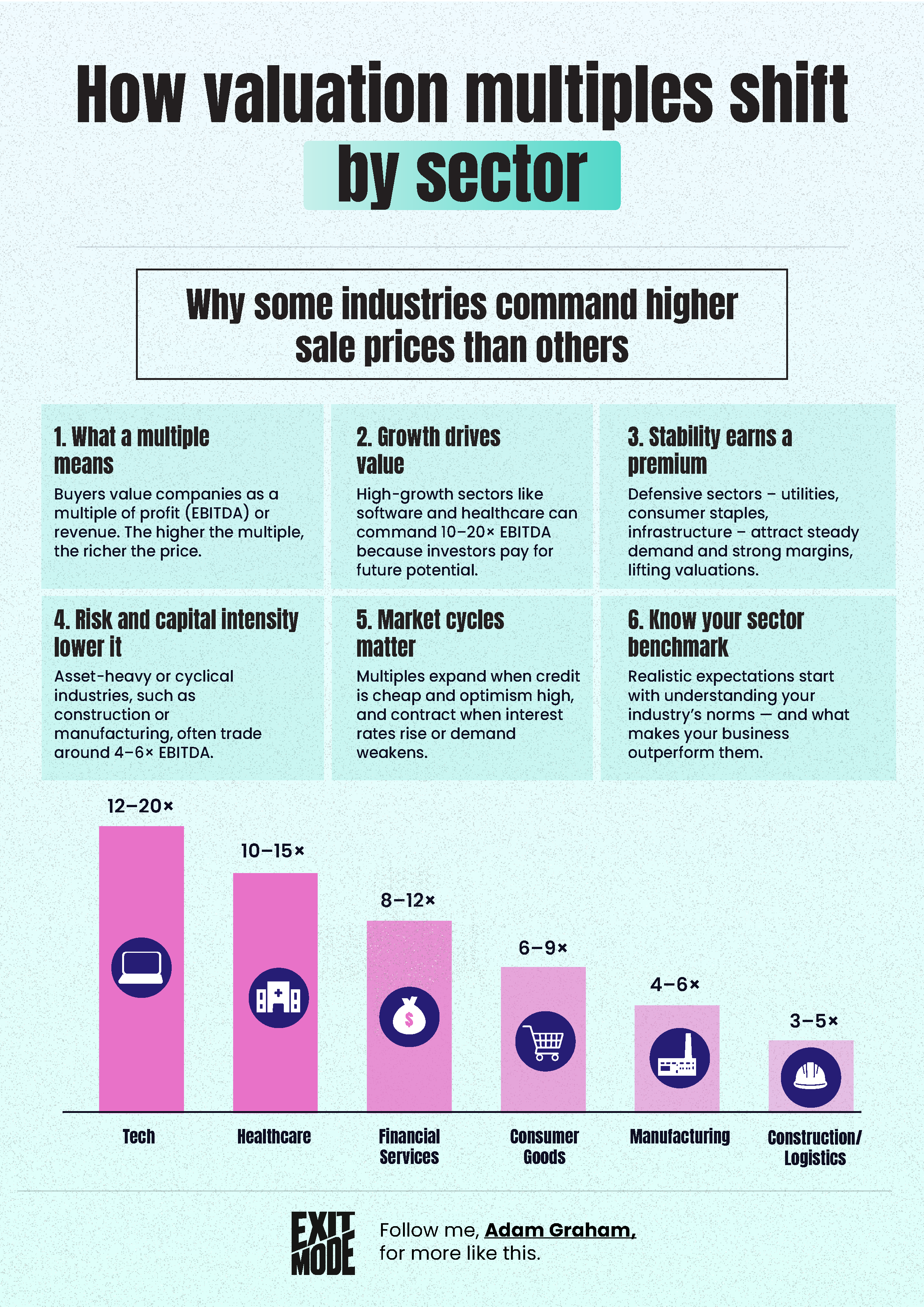
Hi Reader I keep coming back to one idea this week: buyers are paying up to own more of the chain. Rocket Lab did not buy Iridium for its revenue, it bought the ability to control launch, satellites and the network in one place. The same instinct is showing up everywhere, from chip deals to the way the smartest owners build their own companies. The businesses worth the most are the ones that depend least on any single link, including the founder. That is the thread running through everything below. Enjoy! Rocket Lab just paid eight billion to own the whole stackRocket Lab agreed to buy satellite operator Iridium for around $8bn, at a 24 per cent premium, turning itself from a launch provider into a company that controls launch, manufacturing and the network end to end. The market read it as a bet against being one replaceable link in someone else's supply chain. There is a lesson here that scales down to any business. Value concentrates where you own the whole outcome, not a slice of it. The more of the chain you control, the harder you are to squeeze on price, and the more a buyer has to pay to get all of it at once. Read the article here. Apple is testing how much pricing power it really hasApple raised prices across its Mac and iPad lines by $100 to $300, blaming rising memory costs from the AI boom, with the entry MacBook jumping from $599 to $699. What makes it interesting is that there were no new features to justify it, and the stock still wobbled. Pricing power is never unlimited, even for the strongest brand in the world. The real test is whether customers absorb the increase or start shopping around. For the rest of us the takeaway is simpler: pricing power is earned through a value story customers believe, and it erodes the moment you raise prices faster than you raise the reason to pay them. Read the article here. Qualcomm did not buy revenue, it bought capabilityQualcomm agreed to acquire AI software startup Modular for just under $4bn. Modular is barely a revenue story, it is a team and a platform that fills a gap in Qualcomm's stack. This is the version of dealmaking founders should study, because it prices capability rather than trailing profit. When a strategic buyer sees something they cannot easily build, the multiple stops being about your last set of accounts and starts being about what you make newly possible for them. If you are building toward an exit, the question is not only how much you earn, it is what you would let an acquirer do that they cannot do today. Read the article here. IKEA turned a meatball into forty years of goodwillTo mark forty years of its meatball, IKEA leaned into the absurdity rather than protecting the brand's dignity, rolling the anniversary into everything from a new falafel ball to a throwback 1985 price. It works because IKEA understands its meatball is not a product, it is cultural shorthand people feel warmly about. Most companies would have run a tasteful anniversary ad. IKEA treated a side dish as a brand asset worth celebrating loudly. The lesson for smaller businesses is that the things customers genuinely love about you are rarely the things on your pitch deck. Find them, then be brave enough to make them the story. Read the article here. The exit window is cracking open again, selectivelyAfter a long freeze, the IPO market is showing signs of life, with SpaceX's listing widely seen as the catalyst that could reopen the door for everyone behind it. The word doing the heavy lifting is selectively. Exits are returning for businesses that are genuinely ready, not for everyone at once. Windows like this do not stay open indefinitely, and the owners who benefit are the ones who did the boring readiness work before the window appeared, not the ones scrambling to tidy up once it did. Read the article here. The real AI worry is the rung, not the robotA new World Economic Forum and PwC report finds the sharpest AI effect is not mass redundancy, it is the disappearing entry-level rung. Graduates fear preparing for careers that suddenly have fewer first steps because AI now does much of the junior work. For owners this is a strategic problem, not just a hiring one. If nobody does the apprentice years, where does your future senior talent come from? The businesses that think about this now, keeping a deliberate path for people to learn the trade, will have a bench in five years that their competitors let wither. Read the article here. Most companies are secretly two organisationsA sharp piece in Harvard Business Review argues that most companies operate as two organisations at once: the polished version leaders see in dashboards and boardrooms, and the messier reality employees actually live. The gap is not an accident, it is structural. What struck me is how directly this maps onto exit readiness. Buyers do their diligence in the second organisation, the real one, not the one in your deck. If there is a wide gap between the story you tell and the way the business actually runs, due diligence will find it. Closing that gap is not spin, it is the work. Read the article here (paywalled, Archive). A founder stepping back is a test of what he builtOnex founder Gerry Schwartz is stepping down as chief executive after decades in the chair, staying on as chairman while a long-time lieutenant takes over. Founder handovers like this are the moment the business finds out whether it was a company or a personality. The ones that transfer well are the ones where the founder spent years making themselves gradually less essential, not more. If the whole thing runs on you, you have not built an asset, you have built a job that happens to have employees. Read the article here. Your business will not scale until you stop being the bottleneckA practical piece this week on scaling makes an uncomfortable point: the thing holding most growing businesses back is the owner. The fix is not working harder, it is identifying every decision and process that depends entirely on you, then systematically handing it off through hiring, training and consistent check-ins. This connects straight back to the top of the letter. Every deal above was about owning more of the chain, but the one link you want to own less of is yourself. A business that needs you for everything is worth less, not more, because the buyer is really buying you, and you are not for sale. Read the article here. AI prompt of the week: the single-point-of-failure auditThis week is really one question wearing different outfits: how much of your business depends on a single link that could break or walk away? This prompt turns that into a map. Paste it into your preferred model and answer honestly, because vague inputs give you comforting nonsense. You are a pragmatic operations and risk adviser. I run a business with [X] employees turning over roughly [£X]. I am going to describe how it works and I want you to find my single points of failure. First, ask me up to eight questions covering: which decisions only I can make, which relationships live only with me, which customers make up more than ten per cent of revenue, which suppliers have no backup, and which processes exist only in someone's head. Wait for my answers. Then produce three things. One, a ranked list of my top five dependency risks, ordered by how much damage each would do if it disappeared tomorrow. Two, for each risk, the single most practical first step to reduce it in the next ninety days. Three, an honest assessment of how dependent the business is on me personally, and what a buyer would likely discount for it. Be direct. I would rather hear the uncomfortable version now than during due diligence. Framework: why your multiple lives in your sector, not just your numbersThe infographic below maps how valuation multiples shift by sector, and it explains a lot of this week's deals. Two businesses with identical profit can command very different prices depending on the sector they sit in and the strategic story around them. Rocket Lab paid a premium for Iridium because owning the network changed its position in a high-multiple sector, not because Iridium's accounts were remarkable. A chunk of your eventual value is set before you ever negotiate, by the sector you compete in and how essential you are within it. You cannot always change your sector, but you can control how much of the chain you own inside it, and how independent the business is of you. That is the part of the multiple you actually get a vote on.
Drop me a lineWhich single point of failure in your business would scare a buyer most, and be honest, is it a supplier, a customer, or you? Hit reply and tell me. I read everything that lands in my inbox, and the best replies often shape what I write about next. Cheers! Adam |
Adam J. Graham
Serial entrepreneur with 25+ years & 2 exits. Led a publicly traded company to £250M+ valuation. I share the strategies that actually work for scaling businesses & developing leaders. 50,000+ founders read my weekly insights on growth, M&A, and building winning cultures.
Hi Reader I have been turning over the idea this week that almost nothing costs what it says on the label. Not software, not capital, not the cheap channel that stopped working while nobody was watching. The number you agree at the start is only ever the first instalment, and the second one tends to arrive at the moment you have least room to argue with it. Enjoy! The software you have used for fifteen years is not really yours Richard Haldenby runs Salentis, a UK consultancy of about fifteen...
Hi Reader This week I have been musing on how most businesses already contain more growth than their systems can release. The answer is not another channel, product or hire. It is removing the friction that stops good work compounding. I hope you find the following articles inspiring... The next AI advantage may be operational Thrive Holdings has raised $2 billion to acquire services businesses and rebuild how they operate with AI. The interesting part is the model: buy established companies...
Hi Reader I have been thinking about the decisions companies make when they want to move faster. The public version is simple: simplify, focus, accelerate. The harder truth is that speed nearly always has a cost. This week, the best stories were not about ambition itself, but about what leaders were willing to stop, change or risk to make it real. Enjoy! Big deals need more than scale AstraZeneca shares fell after reports that it had held merger talks with Bristol Myers Squibb, a combination...